

Introduction
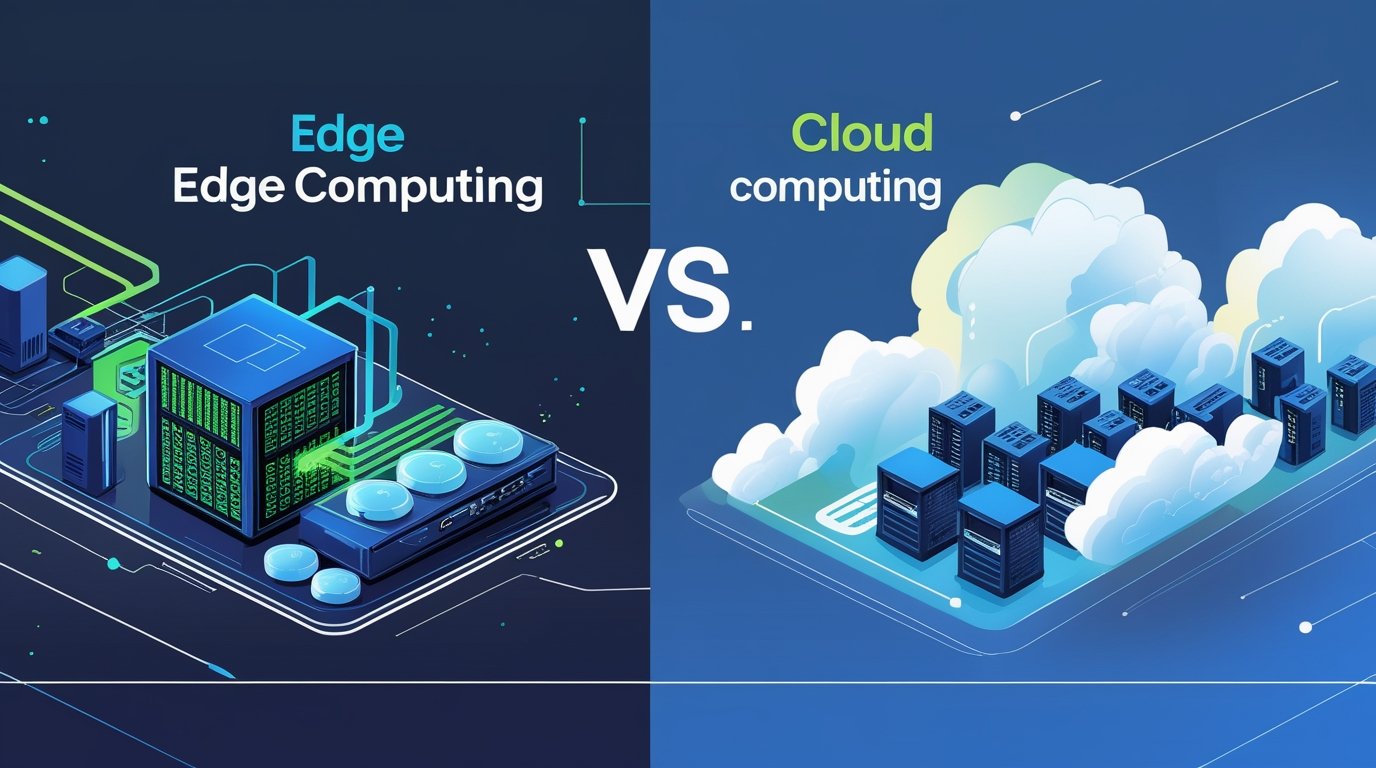
In today’s digital world, data is growing faster than ever. Businesses rely on processing this data efficiently to stay competitive. Two major approaches dominate the scene: cloud computing and edge computing. While cloud computing has been around for over a decade, edge computing is gaining momentum—but what exactly sets them apart? This guide breaks it down in plain English.
What is Cloud Computing?
Cloud computing is the traditional model where data is sent to centralized servers (data centers) to be processed and stored. Services like Google Cloud, AWS, and Microsoft Azure exemplify this model.
Key Features of Cloud Computing
- Centralized Processing: Data travels to the cloud for computation.
- Scalability: Businesses can expand storage or compute power on-demand.
- Accessibility: Data can be accessed from anywhere with an internet connection.
- Managed Services: Providers handle maintenance, updates, and security.
Example Use Case: A video streaming platform like Netflix stores massive video libraries on cloud servers, allowing users worldwide to stream content without local storage.
What is Edge Computing?
Edge computing processes data closer to where it’s generated—on devices or local servers—rather than sending it all to centralized cloud servers. This reduces latency and bandwidth usage.
Key Features of Edge Computing
- Local Processing: Computation happens near the data source.
- Low Latency: Faster responses for real-time applications.
- Bandwidth Optimization: Less data transmitted to the cloud.
- Improved Reliability: Can function even with limited or intermittent internet connectivity.
Example Use Case: Autonomous vehicles rely on edge computing to process sensor data instantly. Delaying data to a cloud server would make real-time driving decisions impossible.
Edge Computing vs Cloud Computing: Head-to-Head
| Feature | Cloud Computing | Edge Computing |
|---|---|---|
| Data Processing | Centralized | Local / near-source |
| Latency | Higher | Very low |
| Bandwidth Use | High | Reduced |
| Scalability | High | Moderate |
| Use Cases | Analytics, backups, SaaS | IoT, AR/VR, real-time apps |
Benefits of Edge Computing
- Faster Decision-Making: Critical for industrial automation and IoT devices.
- Reduced Bandwidth Costs: Only essential data is sent to the cloud.
- Enhanced Security & Privacy: Sensitive data can be processed locally.
- Resilience: Systems can operate offline or during network issues.
Pros & Cons
Cloud Computing
Pros:
- High scalability
- Easy to manage and maintain
- Cost-effective for large-scale storage
Cons:
- Higher latency for real-time applications
- Heavy reliance on internet connectivity
- Data privacy concerns for sensitive information
Edge Computing
Pros:
- Ultra-low latency
- Reduces network congestion
- Better suited for IoT and real-time applications
Cons:
- More complex infrastructure
- Limited scalability compared to cloud
- Requires local hardware investment
Read more: What Are LLMs? A Simple Explanation Without the Jargon
Frequently Asked Questions(FAQs)
1. Can cloud and edge computing work together?
Yes, hybrid approaches combine both. Edge handles immediate processing, while cloud manages storage, analytics, and heavy computations.
2. Is edge computing only for IoT?
No. While IoT benefits the most, edge computing is also useful in healthcare, AR/VR, gaming, and autonomous vehicles.
3. Does edge computing replace the cloud?
Not entirely. Edge complements cloud computing, optimizing performance for specific use cases.
4. What industries benefit most from edge computing?
- Manufacturing & industrial automation
- Autonomous vehicles & transportation
- Healthcare & remote patient monitoring
- Retail (real-time inventory and analytics)
Conclusion
Edge computing is transforming how data is processed, offering speed, efficiency, and reliability where milliseconds matter. While cloud computing remains essential for large-scale storage and analytics, edge computing is the go-to solution for real-time, low-latency applications. Businesses adopting a hybrid model can enjoy the best of both worlds, ensuring scalability, security, and operational efficiency.
